Mlang & Catala
Computing French income tax relies on two domain-specific languages: Mlang, the compiler for the M language created by the DGFiP in the 1990s and still in production, and Catala, designed to turn legal text directly into verified code. We install, customize, and integrate these tools.
Two languages, one goal: turning tax law into code
In the 1990s, France's DGFiP developed the M language, enabling jurists and tax specialists to directly define tax computation rules. Mlang, its modern open source compiler, is still in production today, processing 37 million French tax declarations.
Our role: helping administrations and companies adopt Mlang or Catala, from installation to training their domain teams.
Catala, a project we contribute to
Catala, born at Inria, takes the approach further: a formal semantics that turns legal text directly into verified code. We have contributed to its development. Installation, customization, and integration for our clients are handled directly by our own teams.
Our services around Mlang and Catala
Installation & deployment
We install and configure Mlang and Catala in your infrastructure, on-premise or in the cloud.
Business customization
Adapting computation rules and extending the language to new use cases, working directly with your tax or legal teams.
System integration
APIs and integration with your simulators, calculation engines, and existing information systems.
Training & knowledge transfer
Your legal and technical teams become autonomous on Mlang and Catala.
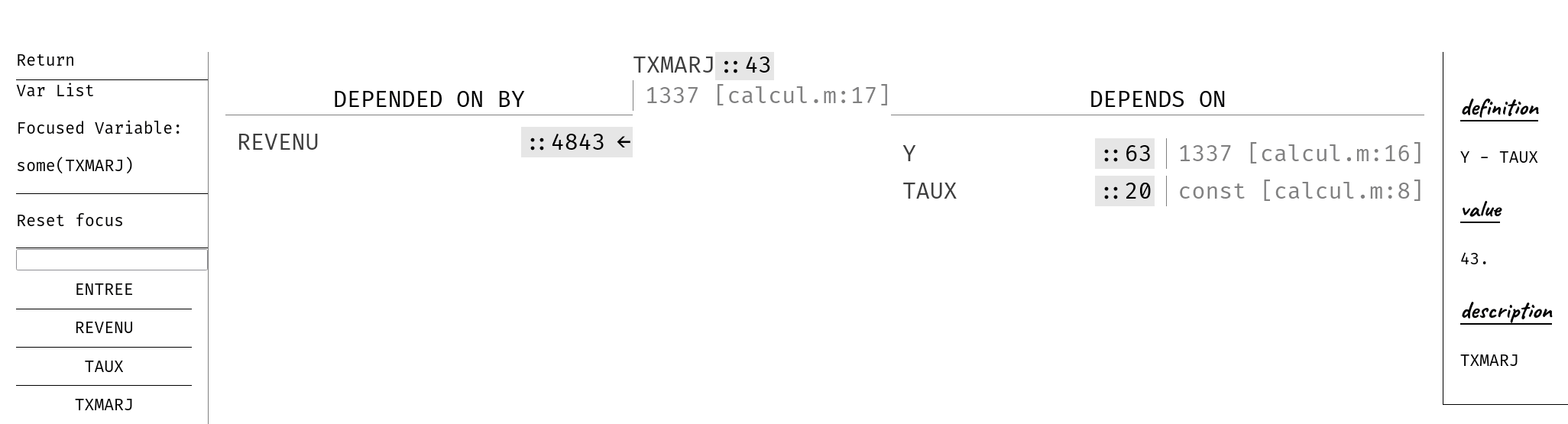
Traceability and debugging
Tools to trace and verify every step of the computation.
Our execution tracing tool lets you follow the complete flow of Mlang and Catala computations, identify anomalies, and verify the accuracy of every step.
Beyond France
Catala's formal semantics lend themselves to encoding any legal text. We support administrations that want to apply this approach to their own legislation.
Tax simulation
Verify computation models upfront to guarantee legislative compliance.
Tax calculation automation
Deploy reliable, scalable tax computation systems for national or regional deployment.
Fiscal chain digitalization
Modernize end-to-end fiscal processes with integrated digital solutions.
Consulting & training
Expert guidance and comprehensive training programs for your teams.
Concrete examples
Ecosystem and evolutions
Mlang and Catala fit into a complete fiscal ecosystem, alongside existing simulators.
Complementary calculation engines
Covering all fiscal situations, including corrections and penalties.
Traceability & readability tools
Enabling jurists and developers to communicate effectively.
Interoperable interfaces & APIs
Facilitating integration with educational simulators and GovTech solutions.
Administration autonomy
Knowledge transfer to maintain and evolve your systems.
Frequently asked questions
What is the difference between Mlang and Catala?
Mlang is the compiler for the M language, created by the DGFiP in the 1990s and still in production. Catala, more recent, turns legal text directly into verified code through formal semantics.
Do you work directly with Catala's creators?
We have contributed to Catala's development, a research project born at Inria. Installation, customization, and integration for our clients are handled directly by our own teams.
What services do you offer?
Installation, customization of business rules, integration with your existing systems, and training for your teams.
Can these languages be used outside France?
Yes, Catala's approach is generic: it applies to any legal text, regardless of jurisdiction.
Are Mlang and Catala open source?
Yes, both are open source, developed with support from Inria and the DGFiP.